Belts, Duty and Junk
A junk WM-2 sells for ¥9,500 on Yahoo Japan. A working one goes for ¥34,400. The spread is in the screwdriver, not the shipping.
Buying Sony Walkmans, Discmans and MiniDiscs in Japan on Yahoo! Auctions, Hard-Off and Mercari and selling them on eBay: what working vs junk is worth, which models carry a spread, refurbishing, testing, batteries and Japan Post, 12.5% US duty, shipping and misdescriptions.
- 46 pages
- 24 sources
- Data: 17 November 2026
46-page PDF + deal sheet spreadsheet. Checkout opens soon.
The short version
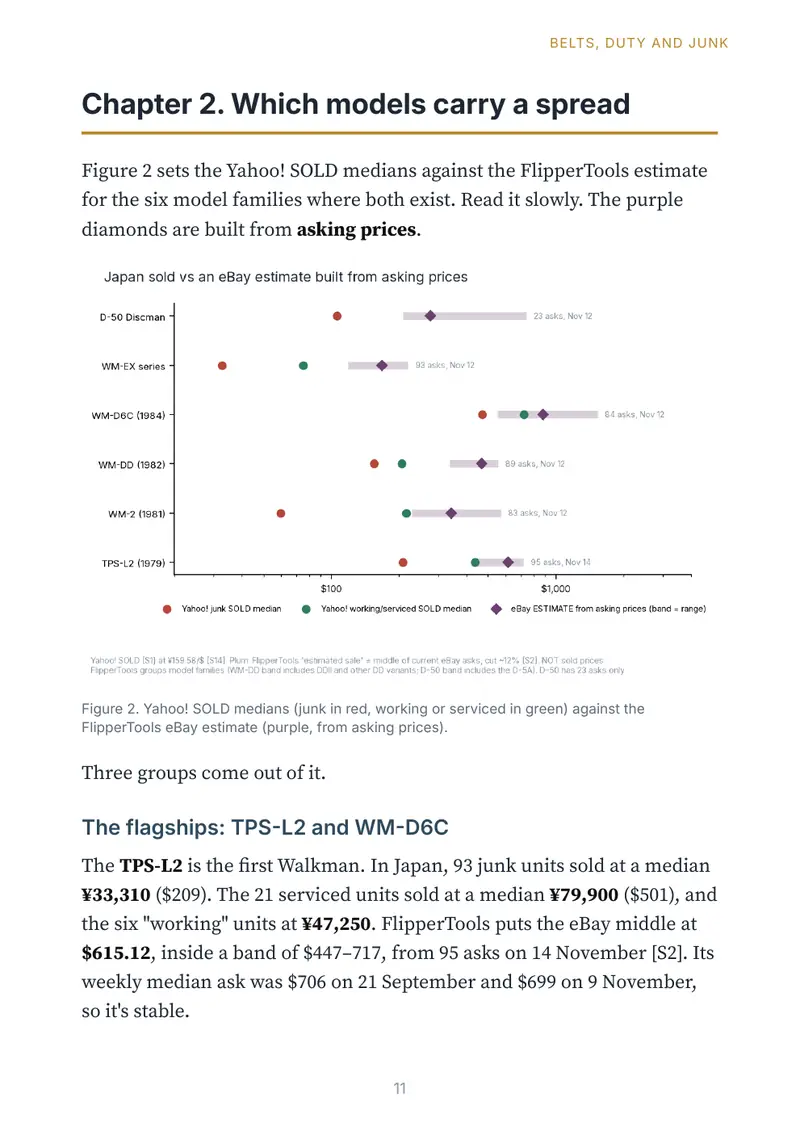
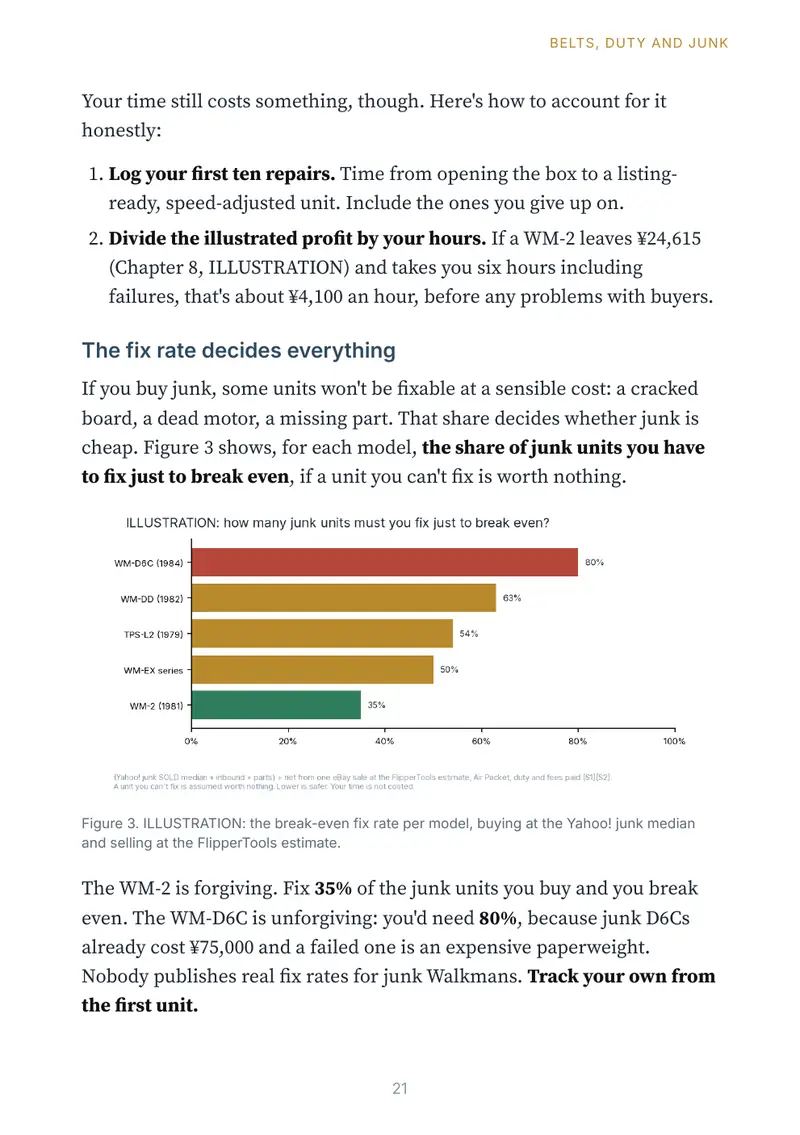
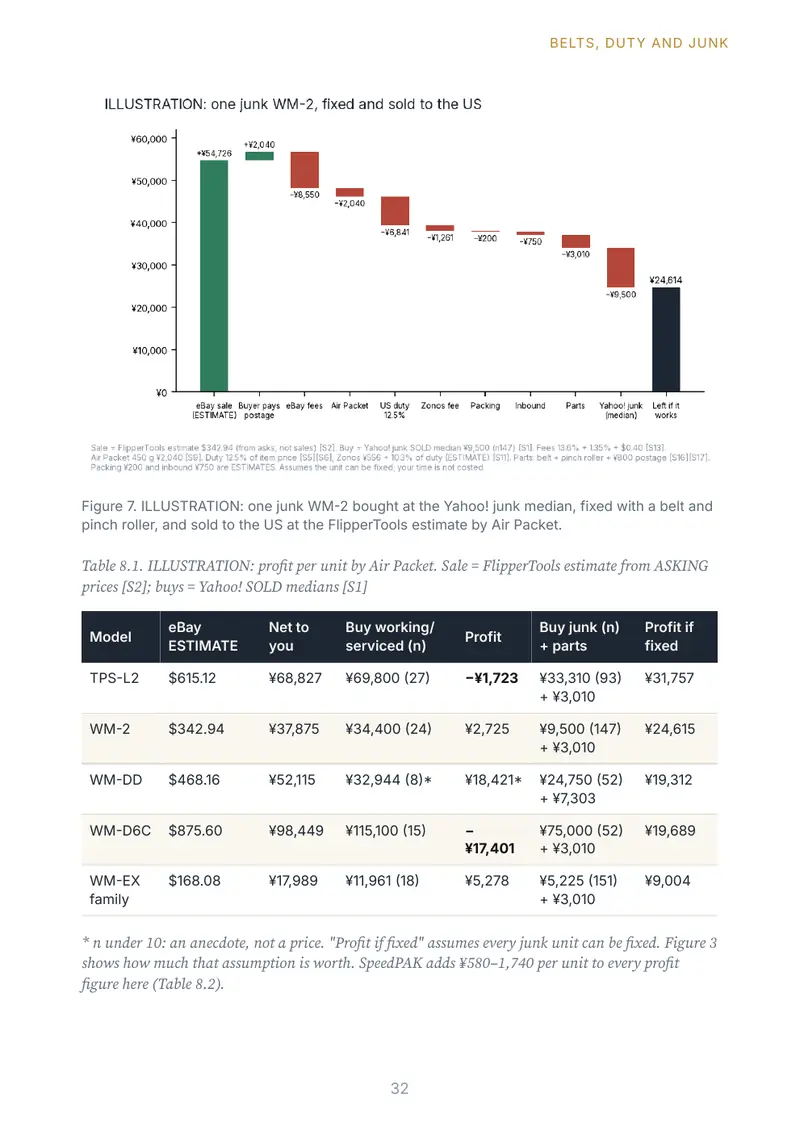
The Japanese side of this book is real: 1,562 single-unit Yahoo! Auctions sales across 12 models, pulled and cleaned by hand. The eBay side isn't, because eBay and the sites that archive it blocked every route to sold prices. So the US numbers are estimates built from asking prices, and every profit figure is labelled ILLUSTRATION, on this page and in the book. What the real data does show clearly is that Japanese sellers already charge a lot more for working units. The gap worth chasing is in junk you can fix, and the book shows what fix rate each model needs.
What the data says
A few numbers from the book, with their labels. Estimates are our calculations, not money anyone has made.
Across 12 models (TPS-L2, WM-2, WM-DD, WM-D6C, WM-EX, D-50 Discman, MiniDisc and more), 21 May–17 November 2026, with bundles, parts and accessories removed.
147 junk sales against 24 working or serviced ones. Japanese sellers already charge more than three times as much for a unit that plays.
n=93 junk and n=27 working. The same pattern holds across the twelve models we tracked.
Illustration only. The sale price is a FlipperTools estimate (~$343) built from eBay asking prices, not sales. The junk figure assumes every unit gets fixed with a belt and pinch roller.
Records and books are exempt. Cassette, CD and MiniDisc players aren't, so duty is the second-biggest cost after eBay fees.
Who it's for
- You can use a screwdriver (or want to learn) and like the idea of bringing old players back to life
- You're in Japan, or buy through a proxy, and want real Japanese sold prices by model and condition
- You prefer a book that tells you where its data is thin over one that hides it
Who should skip it
- Anyone wanting measured eBay profits. We couldn't get eBay sold data, so every profit here is an illustration
- Anyone who won't test, repair or deal with old batteries and solvents. The junk route is where the spread is
What's inside
- 46-page PDF, laid out to read on a phone
- Deal sheet spreadsheet (.xlsx) that works out the most to pay for a 20% margin, working or junk
- 24 numbered sources, our own charts and diagrams
- A five-step bench test, a Japanese condition-word guide and a one-page cheat sheet
Chapters
- Intro: the spread is in the screwdriver
- Where the numbers come from
- Which models carry a spread
- Working vs junk: what the words mean and what fails
- Refurbishing: skills, parts, cost and time
- Testing: a bench routine buyers can trust
- Power, voltage and batteries in the parcel
- US duty and shipping
- The net: five models, illustrated
- Fakes and misdescriptions
- Platforms: where to buy, where to sell
- Cheat sheet
- Sources, samples and what we don't know
Look inside
Real pages from the PDF. Swipe for more.
46-page PDF + deal sheet spreadsheet. Checkout opens soon.
Questions
Why are the profits labelled ILLUSTRATION?
Because the eBay side isn't sold data. eBay blocks automated access to sold listings, and so do the archive sites, so the US prices are estimates built from asking prices plus a handful of individual sales. The Japanese buy prices are real Yahoo! sold medians. Treat every profit figure as a worked example, not a measurement.
Does the book show Sony product photos?
It has four Creative Commons photos from Wikimedia Commons, credited in the book, and no Sony marketing images or listing photos. This site shows no product images at all, just the book's charts and our own artwork.
Do I need repair skills?
For the junk route, basic ones: swapping belts and pinch rollers, cleaning, and testing. Chapter 4 covers skills, parts, cost and time, and Chapter 5 gives a bench test buyers can trust.
How do I get the book after paying?
Checkout gives you a download link straight away and emails you a copy of it. It's a PDF, so it opens on any phone or laptop.
What if it's not what I expected?
If the book isn't what this page describes, email us and we'll refund you. The refund policy has the details.